An online tangent line calculator will help you to determine the tangent line to the implicit, parametric, polar, and explicit at a particular point. Apart from this, the equation of tangent line calculator can find the horizontal and vertical tangent lines as well. So, keep reading to understand how to find tangent line and slope of a tangent line with the help of tangent line equation.
Our previous experience with cusps taught us that a function was not differentiable at a cusp. This can lead us to wonder about derivatives in the context of parametric equations and the application of other calculus concepts. Given a curve defined parametrically, how do we find the slopes of tangent lines? We explore these concepts and more in the next section.
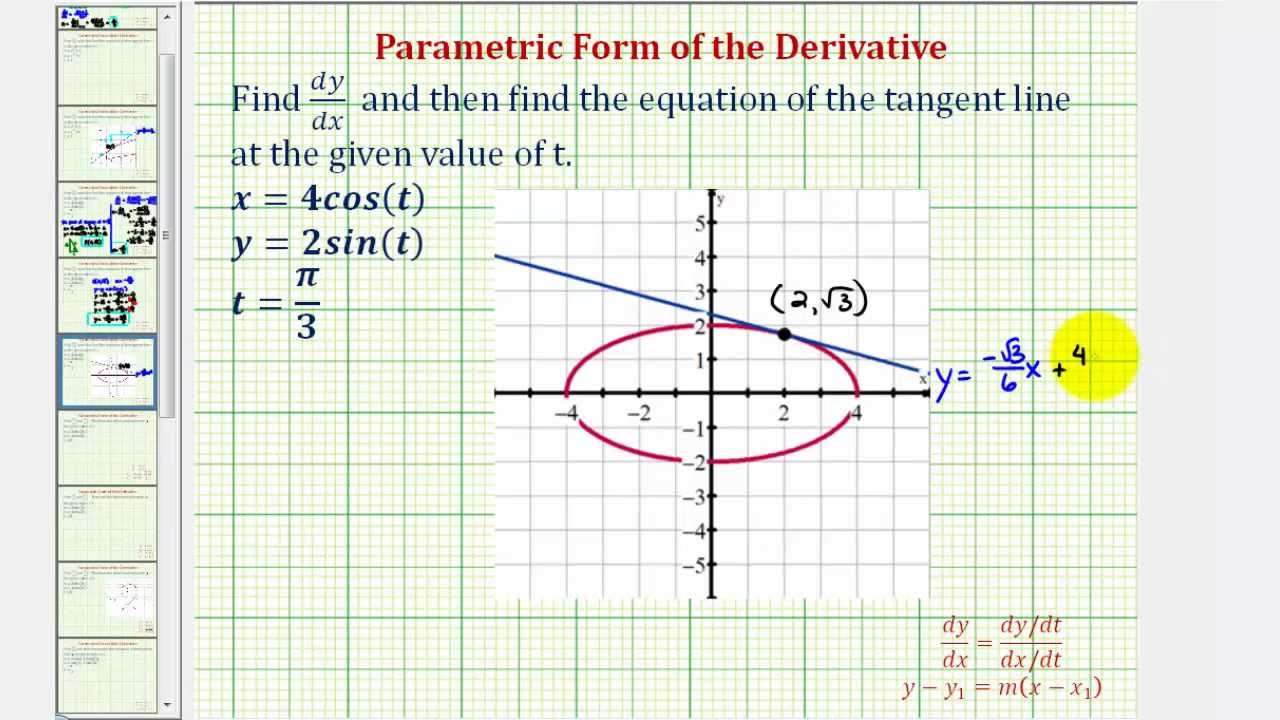
In this lesson, we will focus on finding the tangent and concavity of parametric equations. Just like how we can take derivatives of Cartesian equations, we can also do it for parametric equations. First, we will learn to take the derivatives of parametric equations. Then we will look at an application which involves finding the tangents and concavity of a cycloid. After, we will look at special cases of finding a point with a horizontal tangent. Lastly, we will compare the difference of finding tangents by eliminating and without eliminating the parameter.
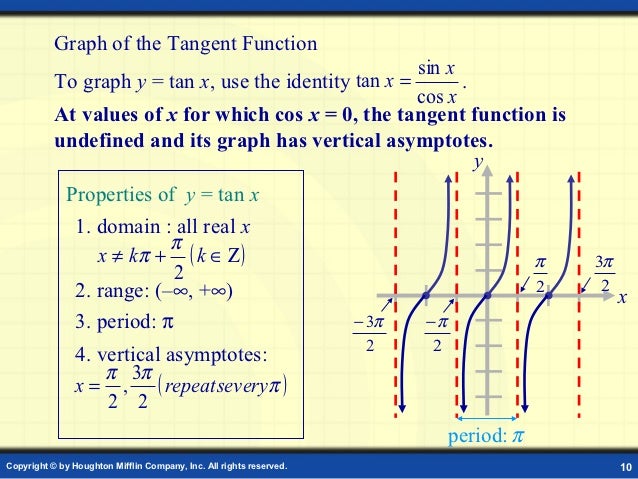
We'll also look at where to find vertical tangent lines, and where to find horizontal tangent lines, since that's something you'll be asked to do often. Horizontal tangent lines exist where the derivative of the function is equal to 0, and vertical tangent lines exist where the derivative of the function is undefined. Thus, equations of the tangents to graphs of all these functions, as well as many others, can be found by the methods of calculus. Secant lines, tangent lines and normal lines are straight lines that intersect a curve in different ways.
A secant line is a line passing through two points of a curve. A line is considered a tangent line to a curve at a given point if it both intersects the curve at that point and its slope matches the instantaneous slope of the curve at that point. On a differentiable curve, as two points of a secant line approach each other, the secant line tends toward the tangent line. The idea of tangent lines can be extended to higher dimensions in the form of tangent planes and tangent hyperplanes.
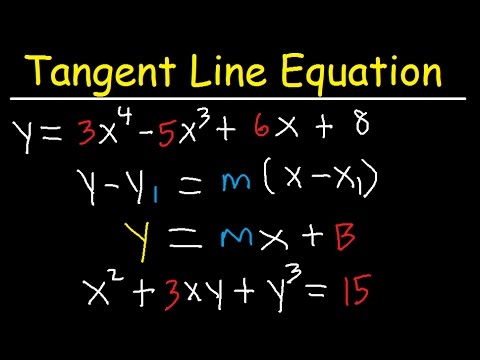
A normal line is a line that is perpendicular to the tangent line or tangent plane. Wolfram|Alpha can help easily find the equations of secants, tangents and normals to a curve or a surface. Thus, we make a distinction between a curve, which is a set of points, and a parametric curve, which is a curve with an orientation imposed on it by a set of parametric equations. A vertical tangent is parallel to y-axis and hence its slope is undefined.
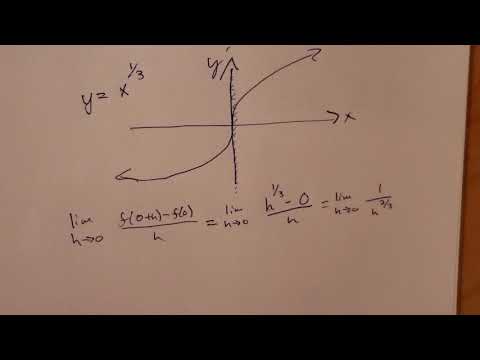
As the slope is nothing but the derivative of the function, to find the points where there are vertical tangents, see where the derivative of the function becomes undefined . After getting the points, we can find the equation of the vertical tangent line using the point-slope form. The vertical tangent to a curve occurs at a point where the slope is undefined . This can also be explained in terms of calculus when the derivative at a point is undefined. There are many ways to find these problematic points ranging from simple graph observation to advanced calculus and beyond, spanning multiple coordinate systems. The method used depends on the skill level and the mathematic application.

The first step to any method is to analyze the given information and find any values that may cause an undefined slope. Determine the \(x\)-\(y\) coordinates of the points where the following parametric equations will have horizontal or vertical tangents. Use this handy tangent line calculator to find the tangent line to the several curves at the given point with a complete solution. Therefore, students and teachers can perform all these calculations manually. However, this is a difficult and time-consuming task.
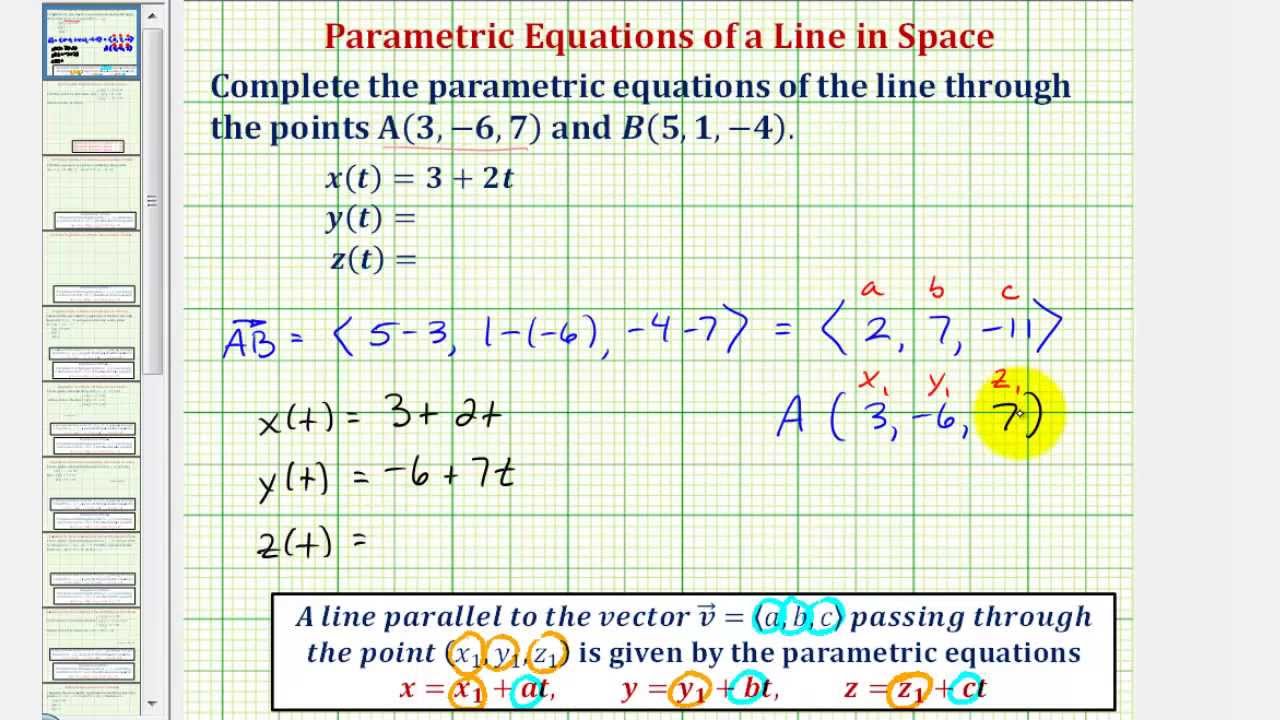
By using an online tangent line equation calculator you can determine tangent lines seamlessly at specific points numerous times. The variable t is called the parameter for the equation. The previous section defined curves based on parametric equations. In this section we'll employ the techniques of calculus to study these curves. We are still interested in lines tangent to points on a curve.
They describe how the \(y\)-values are changing with respect to the \(x\)-values, they are useful in making approximations, and they indicate instantaneous direction of travel. With the notion of a tangent line in hand we are in the position to be able to talk about the speed and velocity of an object whose position is given by parametric equations. In general, given an object traveling in the \(xy\)-plane we can break its movement into two pieces. If we think of these rates of change as vectors then we can use the Pythagorean theorem to talk about the instantaneous speed \(v\) , see Figure3.85.

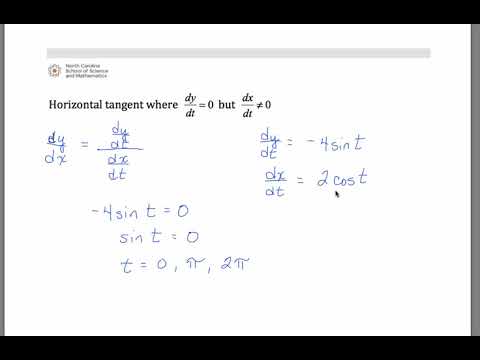
A horizontal tangent is parallel to x-axis and hence its slope is zero. We know that the slope is nothing but the derivative of the function. So to find the points where there are horizontal tangents just set the derivative of the function to zero and solve. After getting the points, we can find the equation of the horizontal tangent line using the point-slope form. We have already seen how to compute slopes of curves given by parametric equations—it is how we computed slopes in polar coordinates.

The formulas above fail when the point is a singular point. In this case there may be two or more branches of the curve that pass through the point, each branch having its own tangent line. Since any point can be made the origin by a change of variables this gives a method for finding the tangent lines at any singular point. These are the values of theta in which the graph of parametric equation will have vertical tangents. Graphs of curves sketched from parametric equations can have very interesting shapes, as exemplified in Figure3.71. In this section we will cover some methods to sketch parametric curves.

In this section, you will study situations in which it is useful to introduce a third variable to represent a curve in the plane. This process is commonly called parameterization and is the basis for our study of parametric curves. The study of curves can be performed directly in polar coordinates without transition to the Cartesian system. After defining a new way of creating curves in the plane, in this section we have applied calculus techniques to the parametric equation defining these curves to study their properties. In the next section, we define another way of forming curves in the plane. To do so, we create a new coordinate system, called polar coordinates, that identifies points in the plane in a manner different than from measuring distances from the \(y\)- and \(x\)- axes.

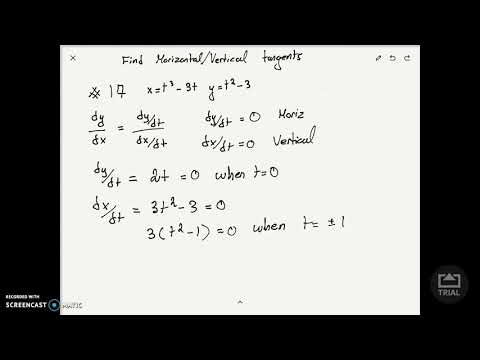
The next topic that we need to discuss in this section is that of horizontal and vertical tangents. We can easily identify where these will occur (or at least the \(t\)'s that will give them) by looking at the derivative formula. The tangent at A is the limit when point B approximates or tends to A. These are the values of theta in which the graph of parametric equation will have horizontal tangents. This video explains how to determine the points on a parametric curve where the tangent lines are horizontal or vertical. Review these basic concepts…Power ruleDerivative of trigonometric functions Derivative of exponential functionsDefining curves with parametric equationsNope, I got it.
Find the coordinates of the points at which the given parametric curve has a horizontal tangent and a vertical tangent. Parametric curve A curve defined as a function of independent variables. For example, a curve in 3-space may be thought of as the path of a moving point and can be described by the values of the position vector r at successive instants in time t. Adding higher-order terms in t past the linear form gives curves of different complexity.

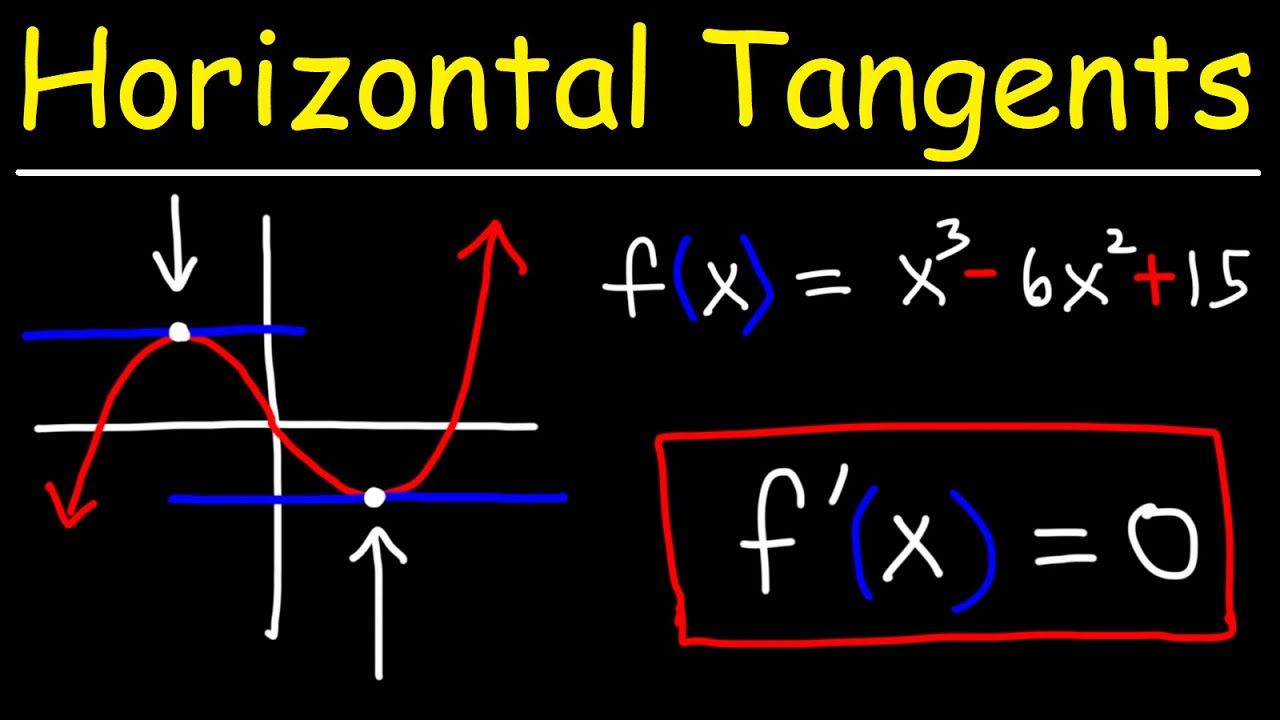
Therefore, when the derivative is zero, the tangent line is horizontal. To find horizontal tangent lines, use the derivative of the function to locate the zeros and plug them back into the original equation. The geometrical idea of the tangent line as the limit of secant lines serves as the motivation for analytical methods that are used to find tangent lines explicitly.

The question of finding the tangent line to a graph, or the tangent line problem, was one of the central questions leading to the development of calculus in the 17th century. Now that we have developed the notion of motion in a straight line for parametric equations we can discuss tangent lines for parametric equations. Observe the graph of the curve notice that, the curve has horizontal tangent lines at the points and . Since the slope is not defined, there is no vertical tangent lines to the given curve.
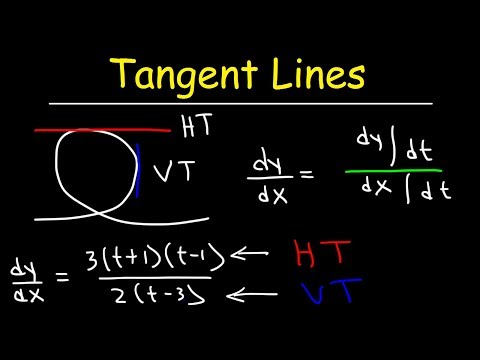
A horizontal tangent line is a mathematical feature on a graph, located where a function's derivative is zero. This is because, by definition, the derivative gives the slope of the tangent line. A tangent of a curve is a line that touches the curve at one point.

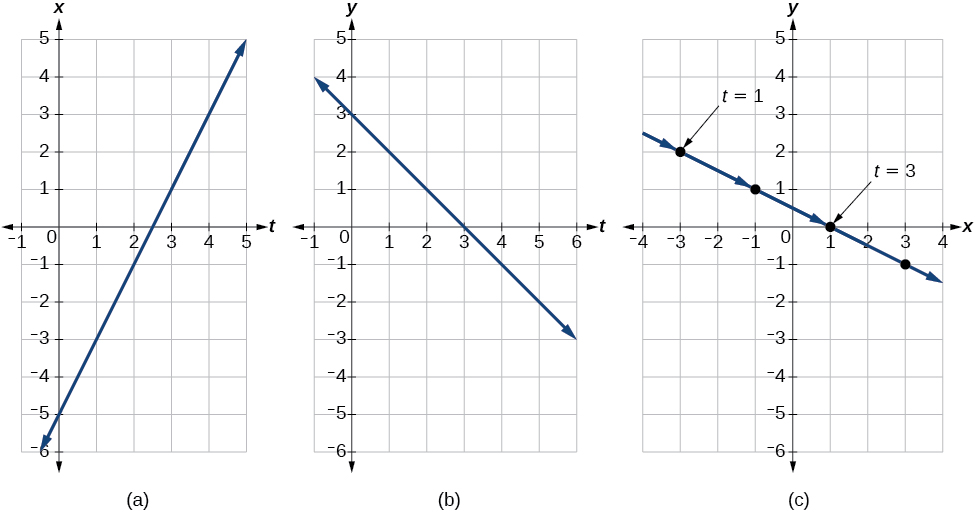
It has the same slope as the curve at that point. A vertical tangent touches the curve at a point where the gradient of the curve is infinite and undefined. On a graph, it runs parallel to the y-axis. For the following exercises, each set of parametric equations represents a line. Without eliminating the parameter, find the slope of each line.
These points correspond to the sides, top, and bottom of the circle that is represented by the parametric equations (Figure 1.19). On the left and right edges of the circle, the derivative is undefined, and on the top and bottom, the derivative equals zero. As I plug multiples of \(\displaystyle \pi\) into the original equation, I get back either or (-1,0), so I know that these points are have vertical tangents. But, I can see from the graph that there are vertical tangents at each multiple of \(\displaystyle \frac \) rather than simply \(\displaystyle \pi\).
T where the curve defined by the parametric equations is not smooth. It is sometimes necessary to convert given parametric equations into rectangular form. This can be decidedly more difficult, as some "simple" looking parametric equations can have very "complicated" rectangular equations. This conversion is often referred to as "eliminating the parameter," as we are looking for a relationship between x and y that does not involve the parameter t.

There's one special case that neither finding the equation of a line nor knowing the magic formula will help with. If f ' is undefined and infinite, then we have a vertical tangent line. The derivative (dy/dx) will give you the gradient of the curve. Find a value of x that makes dy/dx infinite; you're looking for an infinite slope, so the vertical tangent of the curve is a vertical line at this value of x.

In addition to finding the area under a parametric curve, we sometimes need to find the arc length of a parametric curve. In the case of a line segment, arc length is the same as the distance between the endpoints. If a particle travels from point A to point B along a curve, then the distance that particle travels is the arc length. To develop a formula for arc length, we start with an approximation by line segments as shown in the following graph. In mathematics, particularly calculus, a vertical tangent is a tangent line that is vertical. Because a vertical line has infinite slope, a function whose graph has a vertical tangent is not differentiable at the point of tangency.

20., four sets of parametric equations are given. Describe how their graphs are similar and different. Be sure to discuss orientation and ranges. 18., sketch the graph of the given parametric equations; using a graphing utility is advisable.

Be sure to indicate the orientation of the graph. Plots the parametric equations, demonstrating that the graph is indeed of an ellipse with a horizontal major axis and center at . We need to plug the given point into the derivative we just found, but the given point is a cartesian point, and we only have ??? Therefore, in order to plug the given point into the derivative, we need to convert it from a cartesian point into a parameter value for ???

How To Find Horizontal Tangent Lines Parametric To do this, we'll plug the given point into both of the original parametric equations, and look for matching solutions. To find the derivative of the parametric curve, we'll first need to calculate ??? Let us see how to find the slope and equation of the tangent line along with a few solved examples. Also, let us see the steps to find the equation of the tangent line of a parametric curve and a polar curve.

You may need to find the derivative with other derivative rules, such as the quotient rule or chain rule. There is no vertical tangent lines to the given curve. Set the denominator of any fractions to zero. The values at these points correspond to vertical tangents. Find where \(C\) has vertical and horizontal tangent lines.
So, why would we want the second derivative? Well, recall from your Calculus I class that with the second derivative we can determine where a curve is concave up and concave down. We could do the same thing with parametric equations if we wanted to. This is the set of parametric equations that we used in the first example and so we already have the following computations completed.
Therefore with this tangent line calculator, you will be able to calculate the slope of tangent line. However, an online Point Slope Form Calculator will find the equation of a line by using two coordinate points and the slope of the line. The tangent plane to a surface at a given point p is defined in an analogous way to the tangent line in the case of curves.

We now present a small gallery of "interesting" and "famous" curves along with parametric equations that produce them. I have a parametric curve, say two vectors of doubles where the parameter is the index, and I have to calculate the angle of the tangent to this curve at any given point . Finally, plugging the slopes we found and the given point ??????


No comments:
Post a Comment
Note: Only a member of this blog may post a comment.